
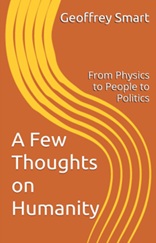
Geoffrey Smart, a past chair of the Society and the instigator, organiser and chair of our public lecture series, has authored a new book entitled A Few Thoughts on Humanity – From Physics to People to Politics. In it, he addresses many of the deepest questions we can ask about humankind: who we are, how we came to be here, why each of us is unique in all time, how chance profoundly shapes our lives, how our values affect others and why this makes all of us responsible for the state of the world.
He also discusses the nature of consciousness, the degree to which other life forms have it, whether AI can acquire it, how much freedom of will we all have, and the implications for responsibility, accountability and justice. Aimed at both scientists and non-scientists, in just 30,000 words, his extraordinary, compellingly written book builds a powerful, science-based case for a kinder, less judgmental and more compassionate world.
In a recent book launch event, he explained that underpinning all the arguments are the laws of physics. He shows how these laws drive all biochemistry, genetics, neuroscience, psychology and decision-making. He explains how life probably began, how evolution works and how physics constrains what we and AI can ever know about the future.
The book has been reviewed during its drafting stages and after publication by several leading intellectuals, including an emeritus professor of theoretical physics from the University of Cambridge, an emeritus professor of genetics from the John Innes Centre and an emeritus professor of humanities from the University of London. Collectively, they have provided extensive input, all of which has been incorporated into the book or used to modify how the arguments are presented.
In summary, the book is about understanding what makes each of us who we are and what the implications are for responsibility, accountability and justice. Every step in the logic Geoffrey presents is consistent with one or more of the eighty plus academic papers that he has referenced in the endnotes, covering physics, genetics, neuroscience, philosophy, psychology, economics and criminology.
Comments on his book include:
- “You develop your analysis with such clarity that even someone who knows as little science as I do can follow with ease. I found it exhilarating that, at the outset, what you emphasise is the uniqueness of each one of us as different collections of atoms.”
- “I admire the way in which, after stressing the centrality of science, you conclude by pursuing the moral and political implications of your account.”
- “I feel sure I will continue to brood about the book, and meanwhile, this note comes with congratulations, and with all best wishes.”
- “I found your book to be informative, interesting and fascinating. I was struck in particular by your assertion that luck plays such an important part in our lives. I enjoyed reading it.”
- “It is a deep-thinking book to be appreciated on any level, whether by scientists or ignoramuses like me”.